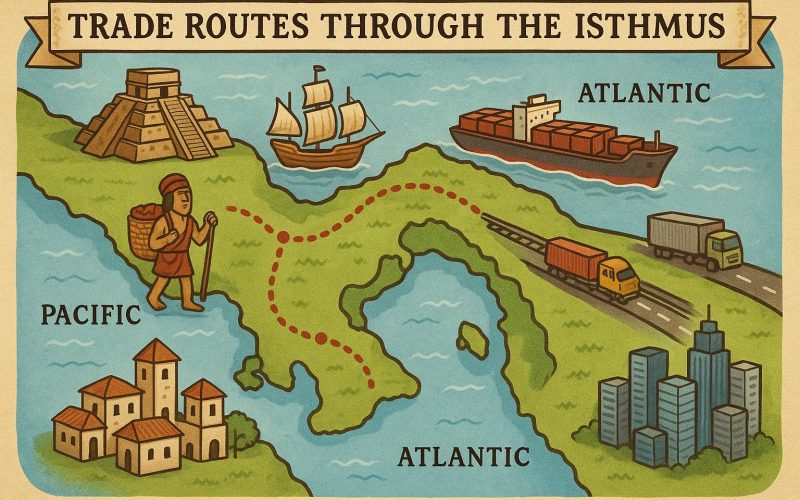
Introduction to the Isthmus as a Historical Trade Route
Throughout history, isthmuses have played pivotal roles as strategic trade routes. An isthmus, defined as a narrow strip of land connecting two larger landmasses and bordered by bodies of water on either side, often provides vital passageways for trade and transportation. These geographic formations have been instrumental in the movement of goods, culture, and ideas, significantly shaping the economies and histories of the regions where they are located.
Significance of Isthmuses in Trade
Isthmuses have historically served as crucial connectors for trade, allowing for more efficient travel across regions. By providing shorter, more direct routes, these land corridors enabled traders and merchants to bypass lengthy and potentially perilous sea voyages. This efficiency reduced travel costs and time, benefiting both economic growth and the dissemination of cultural and technological advancements.
Navigating these narrow strips of land allowed ancient and medieval traders to exploit opportunities for economic expansion that might otherwise have been out of reach. Caravans, laden with goods ranging from spices to silk, utilized these routes as lifelines for trade. Local economies thrived as merchants established bases and rest stops that would become bustling centers of commerce.
The Isthmus of Panama
One prominent example is the Isthmus of Panama, which has been an essential part of global trade networks for centuries. Before the construction of the canal, the Isthmus served as a land bridge for the movement of people and goods between the Atlantic and Pacific Oceans, fostering economic exchange between regions.
The significance of the Isthmus of Panama extends far beyond its geographical appeal. The area’s dense jungles and rugged terrain presented challenges that compelled the creation of the Panama Canal. The canal stands today as a testament to human ingenuity, allowing for the seamless passage of goods in an increasingly interconnected world. The strategic placement of this isthmus made it invaluable for geopolitical maneuvers, especially during the colonial period and the following industrial era. To explore more about its significance, visit this dedicated resource.
The Isthmus of Suez
Another key trade route is the Isthmus of Suez. Similar to Panama, the Suez area became a critical trade passage between Europe and Asia once the canal was constructed. The Suez Canal effectively severed the need for lengthy voyages around the southern tip of Africa, facilitating faster trade routes.
Constructed in the 19th century, the Suez Canal profoundly altered trade dynamics, ushering in a new era of maritime commerce. By dramatically reducing travel times between the Mediterranean and the Indian Ocean, it allowed European powers to consolidate their colonial interests with increased efficiency. As trade routes across the isthmus flourished, so did the exchange of cultural and economic practices. Learn more about its history on this informative site.
Cultural Exchange and Economic Impact
Beyond their economic significance, isthmuses have greatly contributed to cultural exchange. As trade routes, these narrow land passages facilitated the meeting of different cultures, leading to the exchange of languages, traditions, and innovations. This cross-cultural interaction often spurred advancements in science, technology, and the arts, enriching societies far beyond the immediate regions of the isthmus.
The role of isthmuses in this exchange was not merely opportunistic but transformative. Merchants traveling across these land bridges often brought more than material goods; they shared innovations such as paper-making, numerals, and agricultural techniques. In many cases, the cross-pollination of ideas led to hybrid cultures that synthesized disparate traditions, thus weaving a rich tapestry of human history.
These intersections hosted not only the movement of goods but also the spread of major global religions like Christianity, Islam, and Buddhism, which expanded their influence along these travel corridors. The value of isthmuses thus lies in their dual role as both economic and cultural bridges, encompassing the entirety of human experience.
Modern-Day Relevance
Today, the legacy of these historic trade routes continues to impact global commerce. Modern technology has further enhanced their utility; for example, the development of canal systems on these isthmuses has allowed for the passage of larger vessels, increasing trade capacity and efficiency. This modernization showcases the adaptability of ancient trade routes to contemporary economic demands.
In a world where technology and logistics continually evolve, these historic passages have not lost their importance. The canals and routes constructed on isthmuses are routinely upgraded to accommodate modern shipping needs, making these corridors vital components of global supply chains.
Moreover, geopolitically, these regions have become points of strategic interest and contention. Control over such essential trade passages can translate into significant influence over international trade policies and economic stability. As the global community faces challenges like climate change and geopolitical instability, the role of isthmuses in fostering resilient and efficient trade remains crucial.
Conclusion
Isthmuses have been fundamental to historical trade routes, aiding in economic growth, cultural exchange, and technological progress throughout history. Their strategic importance remains evident today, as they continue to facilitate international trade and bolster global connectivity.
The continued relevance of isthmuses in the modern age underscores their foundational role in shaping not only regional but also global dynamics. As focal points of human endeavor, these narrow lands have continually adapted to serve the changing currents of economic and cultural exchange, standing as evergreen staples in the world’s commerce narrative. Whether in ancient times or in today’s highly interconnected world, the legacy of isthmuses as essential trade routes remains ever significant, bridging past, present, and future dynamic exchanges.