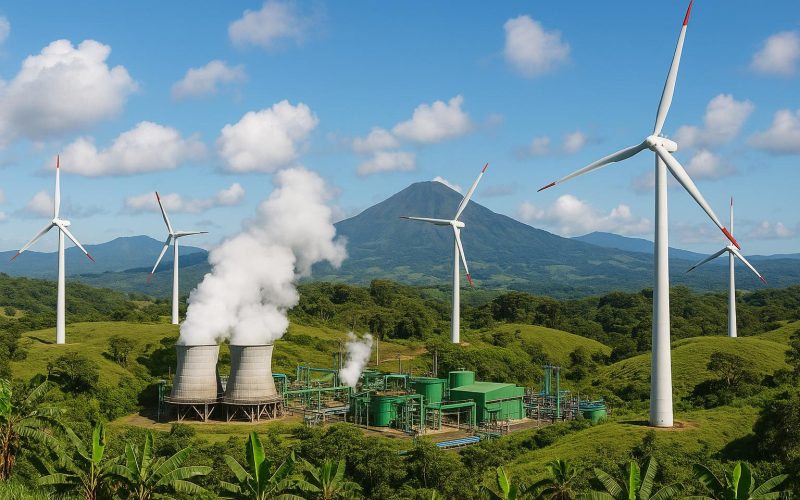
Overview of Renewable Energy in Costa Rica
Costa Rica is often spotlighted for its progressive approach toward renewable energy adoption. Its strategic focus on decreasing reliance on fossil fuels in favor of sustainable alternatives is exemplary on the global stage. Benefiting from advantageous geographic conditions, the country is well-endowed with a diversified array of renewable resources, including hydroelectric, wind, solar, and geothermal energy.
Hydroelectric Power
In Costa Rica, hydroelectric power forms the backbone of the renewable energy sector. The country has capitalized on its abundant rainfall and numerous rivers to support a variety of hydroelectric plants. Ranging from large-scale to smaller localized efforts, these projects effectively transform the kinetic energy of water into a substantial electricity supply. One of the Reventazón Dam, stands as a testament to this form of energy, being one of the largest projects in Central America.
The efficient harnessing of water resources underscores Costa Rica’s commitment to utilizing natural phenomena to meet its energy demands sustainably. The focus on hydroelectricity not only reduces dependency on external energy sources but also aligns with environmental conservation principles by minimally impacting the ecosystem.
Wind Energy
Costa Rica’s topography and geographical positioning form ideal conditions for harnessing wind energy. Initiatives such as the Tejona Wind Farm and Saca Wind Farm exemplify the country’s efforts to effectively capture the relentless trade winds for electricity production. These wind farms are strategically located in mountainous regions where wind speed and reliability are maximized.
The energy generated from these installations is significantly contributing to the national energy grid, showcasing the country’s ability to adapt its natural terrain to generate clean energy. For more on these initiatives, exploring platforms like Costa Rica Wind Energy can provide additional insights into how Costa Rica leads in leveraging wind power for sustainable development.
Solar Energy
Though currently a smaller contributor to the nation’s energy portfolio, solar energy is steadily gaining traction. As costs for solar technology decrease and efficiency rates increase, more governmental and private interest is shifting toward this renewable source. Costa Rica has launched several initiatives, including providing government incentives for residential and commercial solar installations.
These incentives aim to increase the solar footprint, especially in regions where solar potential is high, but current utilization is low. Urban areas are witnessing a gradual integration of solar panels in both new constructions and retrofitted existing buildings, whereas rural areas are exploring solar power as a viable solution for off-grid energy needs.
Geothermal Energy
Geothermal energy stands as a cornerstone of Costa Rica’s renewable energy strategy, owing to the country’s unique positioning along the Pacific Ring of Fire. This geological setting equips Costa Rica with substantial geothermal resources, mainly driven by volcanic activities. The flagship Miravalles Geothermal Field exploits this natural endowment to secure a stable and consistent energy supply.
By converting underground heat into electricity, geothermal projects contribute significantly toward reducing carbon emissions, complementing the more variable solar and wind power sources. With a reliable output unaffected by weather changes, geothermal energy ensures a steady base-load power supply crucial for energy stability.
Government Policies and Goals
Costa Rica’s government has laid down robust policies to synchronize with an envisioned carbon-neutral economy. Through a series of legislative measures, tax incentives, and strategic investments in energy infrastructure, the nation underscores its global environmental commitments. Investments facilitating the expansion and integration of renewable technologies further exemplify the governmental resolve to secure energy independence and bolster economic stability.
Governmental engagement also propels research and development in energy storage solutions and smart grid technologies, necessary to accommodate the growing proportion of renewable sources. The pursuit of international collaborations and public-private partnerships is vital in overcoming technical obstacles, sharing expertise, and gaining access to innovative technologies.
Challenges and Future Directions
Despite Costa Rica’s progressive accomplishments in renewable energy, certain challenges persist. The variability associated with key renewable resources like solar and wind requires adaptive and robust energy storage solutions. Furthermore, maintaining grid reliability amid an increasing share of intermittent energy sources presents ongoing technical challenges.
Addressing these issues is pivotal. Continuous research into energy storage technologies such as batteries or pumped hydro storage, paired with smart grid innovations, could offer practical resolutions. The international community’s support through collaborative efforts and knowledge exchange will be instrumental in realizing Costa Rica’s renewable aspirations.
Conclusion
Costa Rica emerges not only as a pioneer but also as a pragmatic leader for countries considering a transition to renewable energy paradigms. Through a calculated blend of strategic investments and government-backed policies, the nation has established a sustainable, efficient energy ecosystem powered by hydroelectric, wind, solar, and geothermal energy sources.
Looking forward, sustained governmental support, coupled with dynamic international partnerships, remains critical for achieving long-term energy targets. By maintaining momentum in innovation and infrastructure, Costa Rica serves as a guiding light for nations worldwide aspiring toward a future underpinned by clean, renewable energy.